Refinance or Sell? Making the Right Move for Your Home

Homeownership isn’t a one-size-fits-all, and neither are the financial decisions that come with it. At some point, many homeowners reach a familiar fork in the road: Should I refinance my mortgage, or is it time to sell?

The right answer depends on a mix of factors, including your financial health, today’s interest rate environment, your home’s equity, and where you see yourself and your household in the next few years. Let’s walk through both options so you can decide what makes the most sense for you, not just on paper, but in real life.

Refinancing vs. Selling

If your current mortgage no longer feels like the right fit, you generally have two paths forward: refinancing or selling. Refinancing your home allows you to renegotiate the terms of your existing loan, potentially changing your interest rate, loan term, or monthly payment. Selling, on the other hand, can free up equity and open the door to your next chapter. So, how do you decide between the two? The key is to understand what each one offers and what it requires so you can move forward with confidence.

Refinancing Your Home

There are a few reasons homeowners typically refinance their mortgages, the most common being falling interest rates. Lower interest rates after a mortgage reassessment translate into lower monthly payments and significant savings over the life of the loan. If your finances have improved since you initially secured your mortgage—for example, your debt-to-income ratio has improved, or you’ve bumped up your credit score—you may be able to lock in a better rate with your lender. Refinancing your home could also put cash in your pocket. “Cash-out refinancing” allows you to accept a mortgage for more than your principal balance and use the extra money at your discretion. Typically, homeowners will use such funds for significant expenses, such as a major renovation or home improvement project.

Homeowners with Adjustable-Rate Mortgages (ARMs) often refinance into a Fixed-Rate Mortgage to lock in a stable rate for the remainder of the loan term.

Refinancing can also change the length of your loan. Moving from a 30-year mortgage to a 15-year term may reduce the total interest you pay over time, while extending a loan term can lower monthly payments if cash flow is a concern. As with most financial decisions, it’s about balance and knowing the tradeoffs.

Keep in mind that refinancing your home involves getting a new mortgage, so you’ll have to go through the qualification process again. Assess your financial health and equity before you apply. Once you’re ready to move forward, your Windermere agent can recommend a few trusted lenders or mortgage brokers to provide you with a quote.

Selling Your Home

Selling your home is a bigger shift—but sometimes it’s the right one. If your home no longer fits your lifestyle, or if you’re sitting on significant equity, selling can provide financial flexibility to move forward on your terms. Your agent will start by conducting a Comparative Market Analysis (CMA) to determine your home’s value, taking into account current market conditions, location, seasonality, and your home’s unique features.

Although you stand to receive a lump-sum cash payment, selling your home comes with its own set of costs. Paying for repairs, home inspections, staging expenses, agent commissions, not to mention buying or renting your next home, as well as moving fees. This can add up, so it’s important to budget appropriately. Selling your home also means you’ll be uprooting the life you and your household have established there, so it’s necessary to have a plan for your next steps before the “For Sale” sign goes in the ground.


Six Predictions for 2026

The following is a summary of Windermere Principal Economist Jeff Tucker’s six predictions for the U.S. housing market and economy in 2026. He goes into more detail about his predictions in the video below.

1. Existing Home Sales Will Pick Up (Barely)

Home sales have hovered near generational lows for three years. While a sharp rebound is unlikely, conditions point to a modest uptick in 2026. Inventory levels are higher than they’ve been since 2019, and mortgage rates are lower than they’ve been since 2022. Together, those factors should lift existing home sales—but not by much.

2. Home Prices Will Be Roughly Flat

Home prices are likely to remain flat in 2026, largely due to higher inventory putting downward pressure on values. The Case-Shiller Home Price Index showed small declines last summer, though that trend faded by fall. Sellers have been highly responsive to market shifts, often de-listing when offers fall short or holding off on listing altogether. That restraint has kept prices from falling further despite growing supply

3. Inventory Will Climb to Pre-Pandemic Levels

The number of homes for sale will likely return to pre-pandemic levels in 2026, possibly as early as spring. Inventory rose sharply in 2025, and a “shadow supply” of homes—those whose owners are waiting for better conditions—remains in the wings. Many “discretionary sellers” will continue testing the market, holding out for the right price. That behavior should extend average time on market and boost total listings, giving buyers more options and negotiating power.

4. The Homeownership Rate Will Decline

At current prices and interest rates, homeownership remains out of reach for many middle-class Americans who would have bought in different conditions. Slower rent growth has also reduced urgency among would-be buyers, encouraging them to stay put. More renters are opting for single-family homes to enjoy the space and lifestyle of ownership without a mortgage, a shift that will help push the overall homeownership rate slightly lower.

5. Mortgage Rates Will Decline Slightly

Mortgage rates should remain below 6.25% for most of 2026 and could briefly dip under 6%. The Fed’s rate cuts and slower growth have brought 10-year Treasury yields near 4%, while the spread between Treasuries and mortgage rates has narrowed toward its normal range of 2% or less. That trend is expected to continue as refinance risk on mortgage-backed securities gradually fades, but much of the improvement is already reflected in current rates, so significant declines are unlikely.

6. We Will Avoid a Recession in 2026

The U.S. economy weathered several shocks in 2025 but avoided a downturn. Payroll gains have slowed, though more due to shrinking labor supply than weak demand, and unemployment claims have remained stable. After early trade policy turbulence, corporate earnings rebounded strongly, and tariff concerns have faded as court challenges and new trade deals rolled back some of the costliest restrictions.

Strategic Investments to Increase Home Value and Market Appeal

When it’s time to sell your home, one of the biggest questions is how to make it as appealing as possible to today’s buyers. While market conditions, location, and timing all play a role, the updates you choose before listing can make a meaningful difference in both your selling price and how quickly your home goes under contract. The key is knowing where to invest your time and money. Not every project pays off, but some smart upgrades can give your home a competitive edge, help it stand out in online listings, and create the kind of first impression that gets buyers excited.

Here are some of the most impactful ways to invest in your home before putting it on the market.

Fresh Paint and a Neutral Palette

Few improvements have a more substantial return on investment than paint. A fresh coat instantly refreshes a space, making it feel clean, updated, and well-maintained. Neutral tones for interiors, such as soft grays, light beige, and crisp whites, appeal to the broadest audience and allows buyers to envision their own style in the home. It’s crucial not to overlook trim, doors, and even ceilings, as these small details help create a polished, move-in-ready feel. And if your front door could use a pop of personality, consider a bold, welcoming color that complements the rest of the exterior.

Curb Appeal That Counts

Buyers often form an impression before they even step inside. Landscaping, exterior lighting, and simple maintenance go a long way toward making your home inviting. Think trimmed hedges, fresh mulch, pressure-washed walkways, and a tidy lawn. It’s also smart to ensure outdoor areas are safe, from repairing uneven paths to addressing any obvious hazards.

Adding planters with seasonal flowers, updating house numbers, or swapping out an old mailbox can elevate your home’s appearance without requiring a significant investment. For buyers scrolling through listings, that curbside charm can be a deciding factor that gets them to schedule a showing.

Kitchen and Bathroom Touch-Ups

Kitchens and bathrooms continue to be high priorities for buyers, but you don’t need to take on a full remodel to make an impact. Small upgrades like replacing outdated cabinet hardware, installing new light fixtures, or swapping in modern faucets can transform the look of these spaces.

In the kitchen, consider updating your backsplash with a clean, timeless tile or refreshing worn countertops with a durable surface. In bathrooms, regrouting tile, caulking any cracks, replacing mirrors, or updating vanities are simple ways to modernize without overspending.

Flooring Matters

Floors are often one of the first things buyers notice when touring a home. If your carpets are worn or stained, professional cleaning or even replacement can make a big difference. Hardwood floors are especially appealing and refinishing them is often more cost-effective than replacing them.

For areas where replacement makes the most sense, consider durable and stylish options like engineered wood or luxury vinyl plank. Consistent flooring throughout the main living areas can also help a home feel more spacious and cohesive.

Energy-Efficient Features

Today’s buyers are increasingly focused on efficiency and sustainability. Investments like LED lighting, programmable thermostats, and updated appliances not only lower utility bills but also signal to buyers that the home is modern and thoughtfully maintained.

If your budget allows, new windows or improved insulation can add value while appealing to environmentally conscious buyers. Highlighting these upgrades in your listing helps showcase both comfort and cost savings.

Decluttering and Staging

Sometimes the most impactful upgrade isn’t about new finishes, it’s about presentation. Decluttering each room, minimizing personal items, and rearranging furniture to optimize space can dramatically change how buyers perceive your home. And the best part? It’s completely free.

Professional staging takes this one step further, creating a warm and welcoming atmosphere that helps buyers envision living in the space. Even small touches, like fresh flowers, cozy throws, and well-placed artwork, can make your home feel more stylish, comfortable, and truly move-in ready.

Making Smart Choices

The goal of any pre-sale investment is to spend strategically, choosing projects that increase appeal without overextending your budget.

At Windermere, our agents are experts at helping sellers decide which upgrades matter most. From recommending paint colors to connecting you with trusted contractors, we’re here to make sure you get the best return on your investment. Through our Windermere Ready program, we can even front the cost of improvements like painting, landscaping, cleaning, and staging so your home shines its brightest when it hits the market. With concierge-level service and no payments due until closing, it’s a simple way to maximize your home’s value and sell faster.

What is a Buyer-Agency Agreement and Why Does it Matter?

In today’s evolving real estate landscape, one of the biggest changes buyers will encounter is the relatively new requirement to sign a Buyer Agency Agreement. While this added step may sound formal, it’s actually designed to make the home-buying process more transparent, secure, and ultimately more beneficial for everyone involved.

What is a Buyer-Agency Agreement?

At its core, a Buyer Agency Agreement is a written contract between you and your real estate agent. It outlines your working relationship, defining the agent’s responsibilities, the services they’ll provide, the duration of your partnership, and how their compensation will be handled. Think of it as the roadmap for your home-buying journey, ensuring everyone starts on the same page, with mutual understanding and trust.

Starting in mid-2024, the National Association of REALTORS® (NAR) began requiring agents to have a signed buyer agency agreement before showing homes to clients.  This change stems from a nationwide settlement designed to bring greater transparency and accountability to real estate transactions by ensuring all agent-buyer relationships are clearly defined in writing. In some markets, this requirement isn’t new; states like Washington, Idaho, and Utah have long recognized the importance of formalizing this relationship. But for many buyers, this will be their first time signing such an agreement, and understanding its purpose can make all the difference.

So, why does it matter?

Transparency and Trust

This agreement ensures clarity around both compensation and representation. It spells out how your agent is paid—whether by the seller, by the buyer, or by both—so there are no surprises later. With these details defined upfront, you can move forward with confidence, knowing your agent’s focus is squarely on your best interests.

Defined Roles and Responsibilities

A Buyer Agency Agreement clearly outlines what your agent will do for you: from helping you navigate listings and compare neighborhoods to guiding you through offers, inspections, and closing. It also defines your responsibilities as a buyer, such as communicating openly and working exclusively with your chosen agent throughout the duration of the agreement. Together, these expectations create a smoother, more collaborative experience.

Protection and Professionalism

Buying a home is one of life’s biggest investments, and having a written agreement in place protects both you and your agent by setting clear parameters for your working relationship. It ensures your agent is committed to advocating for your needs, maintaining confidentiality, and acting in your best interest throughout the process.

While some may see the Buyer Agency Agreement as an extra step, it’s really a safeguard, one that reinforces the professionalism and dedication that define Windermere Real Estate agents. It turns a handshake of trust into a documented commitment, empowering buyers to make confident, informed decisions at every stage of the journey.

Why AI Can’t Replace Your Real Estate Agent

Technology is transforming nearly every industry, and real estate is no exception. New tools and innovations are reshaping the way we search for, buy, and sell homes. Among these advances, artificial intelligence (AI) has quickly become one of the most talked-about technologies, being used for everything from writing and research to customer service. Naturally, this raises the question of whether it could ever replace jobs that rely on human connection and expertise, like real estate.

In the sections ahead, we’ll break down what AI can and can’t do in real estate, and how agents can use it to their advantage rather than view it as competition.

What is AI?

Artificial intelligence (AI) is technology that allows machines to simulate human intelligence. In recent years, AI has grown at lightning speed and has become part of daily life, often in ways people don’t even notice. Generative AI tools like ChatGPT, Copilot, Gemini, etc., are the ones most people hear about because they can answer questions, draft text, or create images. At the same time, other forms of AI are working quietly behind the scenes on websites, apps, and services we use daily, from recommendation engines to fraud detection.

Together, these tools are changing how we interact with technology, making it faster and more efficient. But when it comes to buying or selling a home, no algorithm can replace the insight, guidance, and personal care of a trusted real estate agent.

How AI is Shaping Real Estate

AI is already influencing how buyers and sellers approach the market. From predictive pricing tools and market analysis platforms to more intelligent home search engines, AI can process large amounts of data and provide insights more quickly than any individual could manage on their own. For agents, it can automate repetitive tasks like drafting emails or creating basic listing descriptions, while chatbots help answer simple client questions around the clock. Some platforms even use AI to match buyers with properties based on preferences or past behaviors. These tools save time and make processes more productive, but they’re only part of the real estate experience.

Why Real Estate Needs a Human Touch

Buying or selling a home is never just about the transaction—it’s often one of the biggest financial and emotional decisions of a person’s life. And while AI may provide quick data or market insights, it can’t sit down with an individual and understand their specific needs, calm their nerves during a stressful moment, or celebrate when the keys are finally handed over.

A real estate agent listens, adapts, and advocates for their clients in ways that no algorithm can replicate, bringing empathy, intuition, and lived experience into the equation rather than just facts and figures. They know the neighborhoods, the schools, and the subtle details that make a house a home. They can recognize when a client needs reassurance, when to negotiate a little harder, and when to suggest a creative solution to keep a deal moving forward. These instincts and skill sets are built on years of human connection, which is what makes the difference between simply completing a deal and guiding someone through a life-changing experience or helping them reach their real estate goals.

The Future: Agents + AI, Not Agents vs. AI

Rather than replacing real estate agents, AI has the potential to make their work even more impactful. Tools like virtual tours, AI-powered staging, and digital imaging can help buyers visualize a property in new ways, while automation can create marketing materials, streamline scheduling, and analyze market trends at an increased speed. These efficiencies free up time and energy for agents to focus on what matters most: listening to clients, building trust, and guiding them through one of life’s most significant decisions.

When used thoughtfully, AI shouldn’t be viewed as a competition, but as a business companion. By blending cutting-edge technology with the irreplaceable human touch, real estate agents can continue to grow their business, deliver better service, and strengthen the personal relationships that remain at the heart of every successful transaction.

What The Ballooning National Debt Means For Housing

For Americans already struggling with the highest mortgage rates in a generation, new legislation out of Washington promises little relief. The “One Big Beautiful Bill Act” (OBBBA) will add trillions to the national debt over the next decades, further cementing an era of expensive borrowing.

The basic laws of supply and demand suggest this surge in government debt issuance will push interest rates even higher for everyone, straining the already-frozen housing market and increasing costs for all types of credit.

The one silver lining, though, is that the sooner lenders accept our “higher for longer” new world of interest rates, the sooner they can stop worrying so much about prepayment risk, which may shrink the spread they charge above 10-year Treasury yields. Below, we’ll explore how national debt impacts real estate.

As Uncle Sam borrows ever more, everyone’s interest rates will rise

The One Big Beautiful Bill Act, enacted this summer, puts the pedal to the metal for debt accumulation over the next decade in the U.S. The Committee for a Responsible Federal Budget estimates that it will add a cumulative $5.5 trillion to the debt by 2034, under the realistic assumption that its provisions written to expire will instead be extended, as has become normal in federal budgeting.

Even taking the expirations at face value, though, the bill raises deficits by a cumulative $4.1 trillion, an extraordinary choice in the midst of an economic expansion and coming on the heels of the worst bout of inflation in decades.

The issuance of trillions of dollars of additional debt in the next several years is expected to drive up interest rates. The Budget Lab at Yale has estimated that the bill will raise 10-year Treasury yields by about half a point in the next several years and by more than 1.4 points in the very long run.

This is driven in part by their modeling assumption that the Federal Reserve will succeed at keeping inflation close to 2 percent, which will require higher interest rates in the long run. They also expect a higher term premium on long-term debt, like 10-year Treasuries.

Altogether, this paints a picture of government borrowing crowding out private borrowing — as the Treasury issues more debt to finance its deficits, yields must rise to compensate investors. Other debt in the economy, such as mortgages, must yield more as well, in order to compete with Treasury bonds for lenders.

High interest rates have already frozen the housing market

While the U.S. economy continues to grow, the U.S. housing market has been stuck in neutral for over three years. Ever since mortgage interest rates rebounded from all-time lows below 3 percent for 30-year loans in 2020 and 2021, to generational highs above 7 percent in 2023, existing-home sales have been stuck in the neighborhood of 4 million annual sales.

It’s no surprise that fewer homes are changing hands than during the 2021 low-interest-rate boom, but 4 million is much fewer than even prevailed during the 2010s. In fact, 2024’s total of 4.06 million existing-home sales was the lowest total since the 1990s. The housing market is caught in a perfect storm, keeping homeowners frozen in place, thanks to the one-two punch of high price-to-income ratios and high mortgage rates.

While the OBBBA includes some sweeteners for certain homeowners, like the expansion of the state and local tax deduction cap to $40,000, the main long-term effect it promises for housing is just higher interest rates.

One near-term trend likely to help mortgage borrowers: a thinner spread

Bigger deficits, bigger debt, higher interest rates — the long-term fiscal outlook is getting darker. But there’s one silver lining that has begun to shine around the edge of these gathering clouds. The mortgage-Treasuries spread has begun to narrow again, resuming its progress back down toward pre-pandemic levels. The spread, here, refers to how much higher 30-year mortgage rates are averaging than 10-year Treasury yields.

In the 21st century, up to the pandemic, mortgage rates rarely exceeded 10-year Treasury yields by more than 2 percentage points, except during the global financial crisis. When mortgage rates soared back up in 2022, part of their climb was due to the widening spread. The two major reasons for widening spreads are a greater prepayment or refi risk on mortgages and interest rate volatility.

The latter has gradually faded this summer after spiking amidst tariff uncertainty in April. But the prepayment risk component is the bigger factor. For lenders and the investors who buy mortgage-backed securities, mortgages issued at high interest rates are uniquely risky because borrowers are expected to refinance them once mortgage rates fall back down.

The lack of a prepayment penalty for borrowers makes U.S. mortgages uniquely favorable to homebuyers here. If rates rise, they win by virtue of having locked in a lower rate; if rates fall, they can always refinance. Investors and lenders, by the same token, view refinancing as a unique downside to holding mortgages. They want a reliable coupon stream from mortgage holders’ monthly payments.

Seeing their loans wiped out by refinancing, replaced by cash in a new lower-interest-rate world, is a risk for which they must be compensated to make the loan in the first place.

That extra compensation for prepayment risk helped explain why mortgage rates soared even more than 10-year Treasury yields in 2022 and 2023. Now, though, as the reality sets in that we are living in a world where interest rates are “higher for longer,” lenders have gradually brought mortgage rates down relative to Treasuries, from about a 2.9-point spread in 2023 to 2.4 in recent months, or about one-third of the way back to normal.

The sooner investors conclude that refinancing prepayment risks aren’t so high, the sooner the spread can come down. The potential bankshot silver lining of the OBBBA? By putting a nail in the coffin of hopes for low interest rates, it may help further shrink the spread, so that higher 10-year Treasury yields don’t have to mean higher mortgage rates one-for-one.

Ultimately, the nation’s fiscal path points toward a new normal of higher borrowing costs for all. The “One Big Beautiful Bill Act” serves as an accelerant, solidifying a “higher for longer” interest rate environment that will impact everything from car loans to corporate debt. For the beleaguered housing market, this presents a bittersweet trade-off.

The bad news is that the foundational interest rate, the 10-year Treasury yield, is set to climb. The paradoxical good news is that by killing the hope of a return to ultra-low rates, the OBBBA may continue to shrink the risk premium lenders charge on mortgages. This narrowing spread won’t turn 7 percent mortgages back into 3 percent loans, but it might help us work our way back down closer to 6 percent.

Jeff Tucker is the Principal Economist at Windermere Real Estate in Seattle, WA. This blog was originally published on Inman News on 8/26/25.

Here’s a video walkthrough of my new Seattle listing, a 1903 gem! – Check it out and come visit my open houses. 719 19th Ave More Info

Saturday 5/14/22:   Noon – 3:00 p.m.

Sunday 5/15/2022:   1:00 to 4:00 p.m.


What You Can Expect from the Spring Housing Market

What You Can Expect from the Spring Housing Market | MyKCM

As the spring housing market kicks off, you likely want to know what you can expect this season when it comes to buying or selling a house. While there are multiple factors causing some uncertainty, including the conflict overseas, rising inflation, and the first rate increase from the Federal Reserve in over three years — the housing market seems to be relatively immune.

Here’s a look at what experts say you can expect this spring.

1. Mortgage Rates Will Climb

Freddie Mac reports the 30-year fixed mortgage rate has increased by more than a full point in the past six months. And despite some mild fluctuation in recent weeks, experts believe rates will continue to edge up over the next 90 days. As Freddie Mac says:

“The Federal Reserve raising short-term rates and signaling further increases means mortgage rates should continue to rise over the course of the year.”

If you’re a first-time buyer or a seller thinking of moving to a home that better fits your needs, realize that waiting will likely mean you’ll pay a higher mortgage rate on your purchase. And that higher rate drives up your monthly payment and can really add up over the life of your loan.

2. Housing Inventory Will Increase

There may be some relief coming for buyers searching for a home to purchase. Realtor.com recently reported that the number of newly listed homes has grown for each of the last two months. Also, the National Association of Realtors (NAR) just announced the months’ supply of inventory increased for the first time in eight months. The inventory of existing homes usually grows every spring, and it seems, based on recent activity, the next 90 days could bring more listings to the market.

If you’re a buyer who has been frustrated with the limited supply of homes available for sale, it looks like you could find some relief this spring. However, be prepared to act quickly if you find the right home.

If you’re a seller, listing now instead of waiting for this additional competition to hit the market makes sense. Your leverage in any negotiation during the sale will be impacted as additional homes come to market.

3. Home Prices Will Rise

Prices are always determined by supply and demand. Though the number of homes entering the market is increasing, buyer demand remains very strong. As realtor.com explains in their most recent Housing Report:

“During the final two weeks of the month, more new sellers entered the market than during the same time last year. . . . However, with 5.8 million new homes missing from the market and millions of millennials at first-time buying ages, housing supply faces a long road to catching up with demand.”

What does that mean for you? With the demand for housing still outpacing supply, home prices will continue to appreciate. Many experts believe the level of appreciation will decelerate from the high double-digit levels we’ve seen over the last two years. That means prices will continue to climb, just at a more moderate pace. Most experts are predicting home prices will not depreciate.

Won’t Increasing Mortgage Rates Cause Home Prices To Fall?

While some people may believe a 1% increase in mortgage rates will impact demand so dramatically that home prices will have to fall, experts say otherwise. Doug Duncan, Senior Vice President and Chief Economist at Fannie Maesays:

“What I will caution against is making the inference that interest rates have a direct impact on house prices. That is not true.”

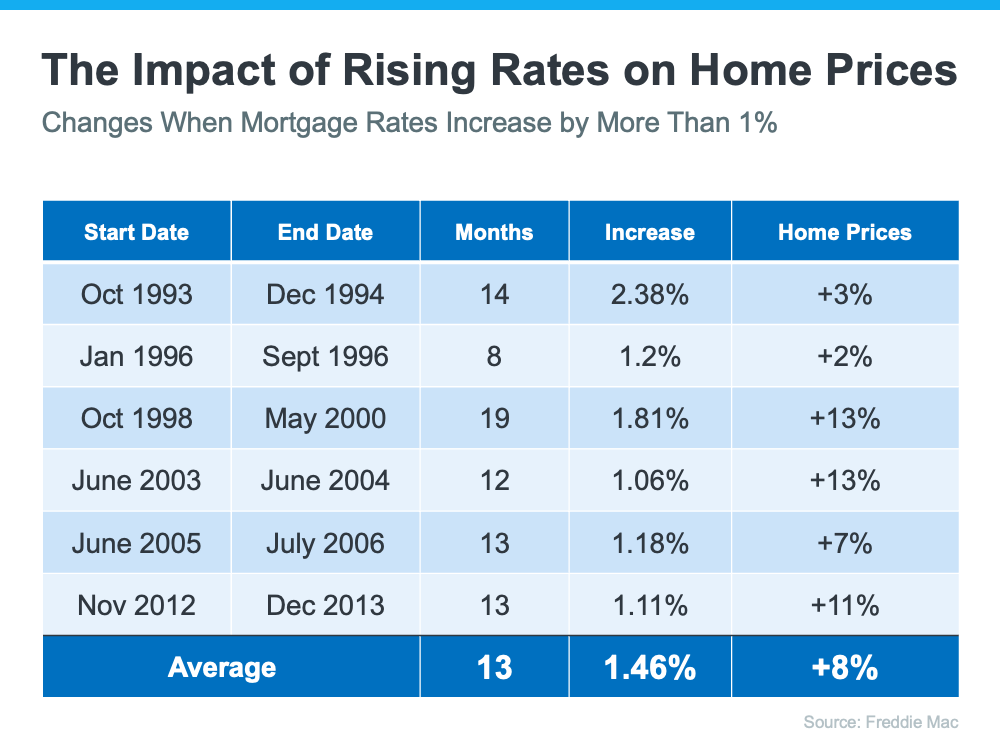
Freddie Mac studied the impact that mortgage rates increasing by at least 1% has had on home prices in the past. Here are the results of that study:

What You Can Expect from the Spring Housing Market | MyKCM

As the chart shows, mortgage rates jumped by at least 1% six times in the last thirty years. In each case, home values increased.

So again, if you’re a first-time buyer or a repeat buyer, waiting to buy likely means you’ll pay more for a home later in the year (as compared to its current value).

Bottom Line

There are three things that seem certain going into the spring housing market:

  1. Mortgage rates will continue to rise
  2. The selection of homes available for sale will modestly improve
  3. Home prices will continue to appreciate, just at a slightly slower pace

If you’re thinking of buying, act now before mortgage rates and home prices increase further. If you’re thinking of selling, your best bet may be to sell soon so you can beat the increase in competition that’s about to come to market.

Check out Monday with Matthew economic report. Great data and easy to digest.

https://www.windermere.com/blog/matthew-gardner-covid-19-housing-economic-update-01-25-2021


From Search to Signature,

Colleen McCann.


According to GeekWire, LinkedIn migration data indicates that Seattle techies are not leaving Seattle, unlike the “exodus” in Silicon Valley. The article by Talyor Soper shows that Seattle added 2.2 tech workers for every one that left, just below 2.5 for last year.

Our real estate view is that tech business growth will continue to be an important demand factor for Seattle housing. This is good for sellers and buyers need to be as thorough and nimble as ever.

Happy New Year!

Colleen McCann